

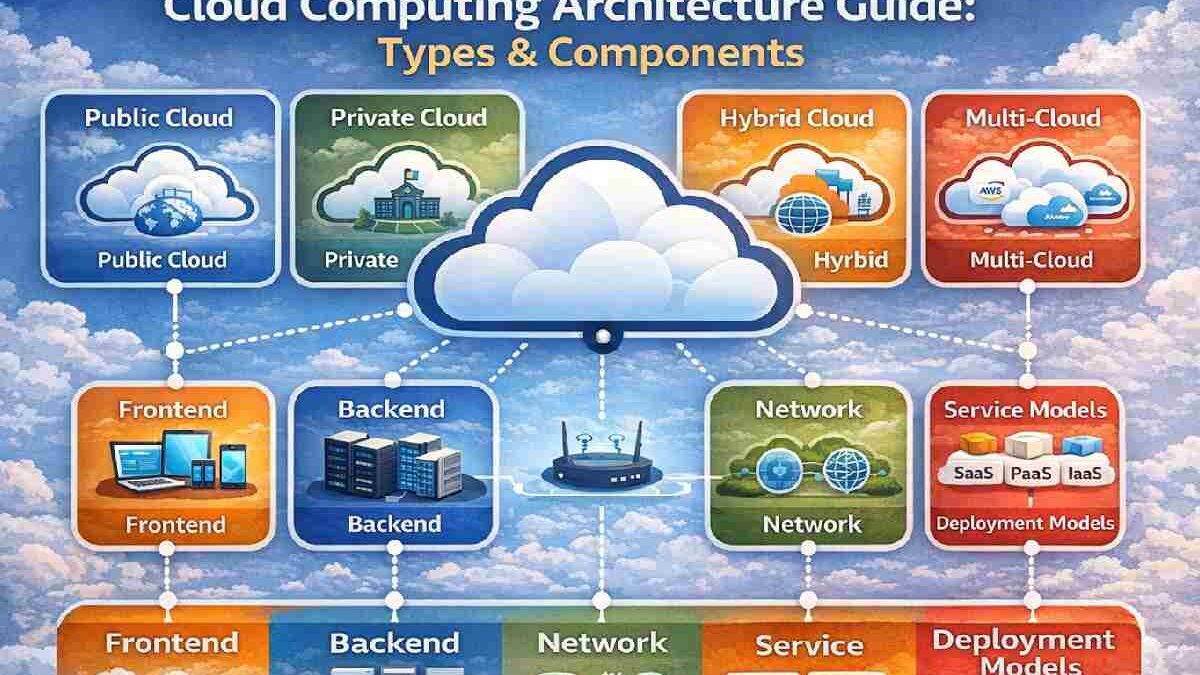
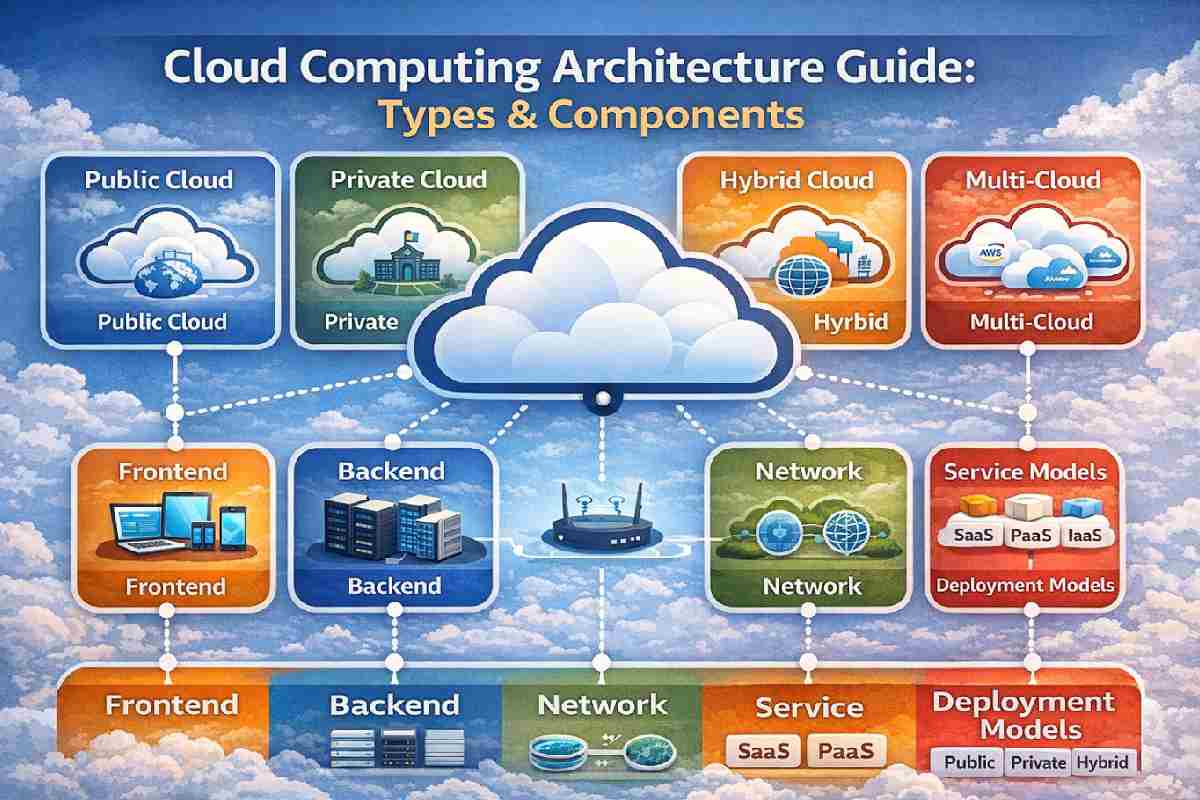
Cloud computing architecture is the backbone of modern digital infrastructure. From startups to global enterprises, organizations rely on it to deliver scalable, secure, and high-performance services. In this research-based guide, you’ll learn everything about cloud computing architecture, including its components, types, benefits, management, and career opportunities.
Table of Contents
What is Cloud Computing Architecture?
Cloud computing architecture refers to the combination of components required for cloud services, including front-end platforms, back-end infrastructure, cloud-based delivery, and network systems.
It defines how cloud resources are structured, managed, and delivered over the internet.
- Frontend (client-side interface)
- Backend (servers, storage, databases)
- Cloud delivery models
- Network and virtualization
H2 IMAGE SECTION 1 (Add After Intro)
Cloud Computing Architecture Overview Diagram
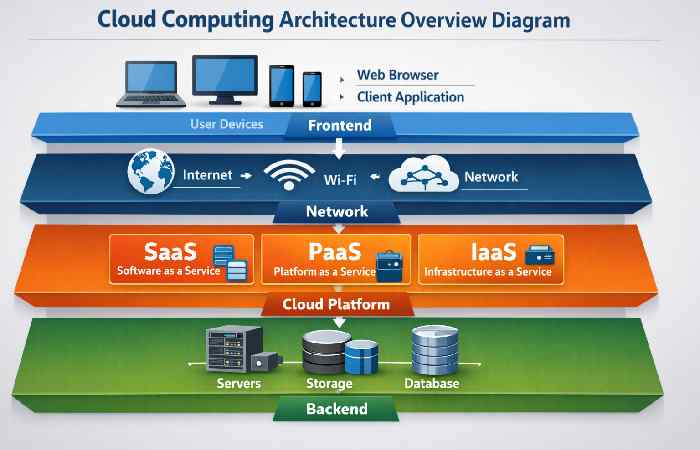
Cloud Computing Architecture and Its Components
Understanding cloud computing architecture and its components is essential for mastering cloud systems.
Core Components Table
| Component | Description | Examples |
| Frontend | User interface or client devices | Browser, mobile apps |
| Backend | Servers, storage, databases | AWS EC2, Azure VMs |
| Cloud Infrastructure | Virtual machines, containers | Kubernetes, Docker |
| Network | Internet and intranet connections | TCP/IP, VPN |
| Middleware | Software connecting frontend and backend | APIs, messaging queues |
| Management Layer | Monitoring, security, automation | CloudWatch, Azure Monitor |
How Cloud Computing Architecture Works
It operates by distributing workloads across multiple servers using virtualization.
- Virtualization enables resource sharing
- Load balancing distributes traffic
- APIs connect services
- Data is stored in distributed databases
- Scalability adjusts resources dynamically
- Multi-tenancy supports multiple users
- Security layers protect data
- Automation reduces manual tasks
- Monitoring ensures performance
- Backup systems prevent data loss
Types of Cloud Computing Architecture
Types Comparison
| Type | Description | Use Case |
| Public Cloud | Shared infrastructure | Web apps, SaaS |
| Private Cloud | Dedicated environment | Banking, healthcare |
| Hybrid Cloud | Combination of public & private | Enterprise workloads |
| Multi-Cloud | Multiple cloud providers | Risk management |
Cloud Service Models
| Service Model | Description | Examples |
| IaaS | Infrastructure resources | AWS EC2 |
| PaaS | Development platform | Google App Engine |
| SaaS | Software delivered via cloud | Gmail, Salesforce |
Amazon Web Services Architecture Center
https://aws.amazon.com/architecture/
Best for: Real-world architecture diagrams, case studies
Microsoft Azure Architecture Guide
https://learn.microsoft.com/en-us/azure/architecture/
Cloud Computing Architecture and Management
Cloud management ensures smooth operation of it.
- Resource provisioning
- Performance monitoring
- Cost optimization
- Security enforcement
- Compliance management
- Backup and recovery
- Identity and access control
- Automation tools
- Workload balancing
- Service orchestration
Benefits of Cloud Computing Architecture
- Scalability
- Cost efficiency
- Flexibility
- High availability
- Disaster recovery
- Security features
- Global accessibility
- Automatic updates
- Resource optimization
- Faster deployment
Cloud Architecture vs Traditional Architecture
Comparison Table
| Feature | Cloud Architecture | Traditional IT |
| Scalability | High | Limited |
| Cost | Pay-as-you-go | High upfront cost |
| Maintenance | Managed by provider | In-house |
| Accessibility | Anywhere | Limited |
| Deployment Speed | Fast | Slow |
Security in Cloud Computing Architecture
Security is a critical part of cloud computing architecture.
- Security Measures
- Data encryption
- Firewalls
- Identity management
- Multi-factor authentication
- Security audits
- Intrusion detection
- Backup systems
- Compliance standards
- Secure APIs
- Monitoring tools
Recommended Resources:
- NIST Cloud Computing Framework
- AWS Architecture Center
- Microsoft Azure Architecture Guide
- Google Cloud Architecture Framework
Tip: Add outbound links here to improve SEO authority and trust.
Career: Cloud Architect Salary & Skills
Salary Table
| Country | Average Salary |
| India | ₹15–40 LPA |
| USA | $120K–$180K |
| UK | £70K–£120K |
Skills Required
- Cloud platforms (AWS, Azure, GCP)
- Networking
- Security
- DevOps tools
- Programming (Python, Java)
- Containers (Docker, Kubernetes)
- Automation
- Database management
- Architecture design
- Problem-solving
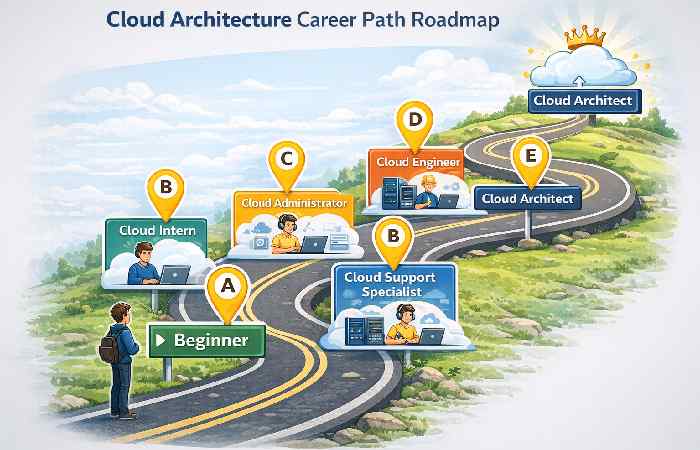
Cloud Architecture Career Path Roadmap
Cloud Computing Architecture Worldwide: Top 10 Countries
It adoption varies globally based on infrastructure, technology investment, data regulations, and enterprise demand. The global cloud market is dominated by a few leading countries, especially due to the presence of hyperscale providers like AWS, Azure, and Google Cloud, which together control over 60% of global cloud infrastructure.
Top 10 Countries in Cloud Computing Architecture (Global Ranking)
| Rank | Country | Key Strengths in Cloud Architecture | Major Cloud Providers Presence |
| 1 | United States | Innovation, hyperscale data centers, AI integration | AWS, Azure, Google Cloud |
| 2 | China | Government-backed cloud growth | Alibaba Cloud, Tencent Cloud |
| 3 | India | Fast-growing digital economy, startups | AWS, Azure, GCP |
| 4 | Germany | Strong enterprise adoption, data privacy | SAP Cloud, AWS |
| 5 | United Kingdom | Financial cloud services, fintech | Azure, AWS |
| 6 | Japan | Advanced infrastructure, IoT | Fujitsu Cloud, AWS |
| 7 | Canada | Government cloud adoption | AWS, Azure |
| 8 | Australia | Cloud-first policies | AWS, Google Cloud |
| 9 | Singapore | Asia-Pacific cloud hub | AWS, Alibaba Cloud |
| 10 | South Korea | High-speed networks, smart tech | Naver Cloud, AWS |
Why These Countries Lead in Cloud Computing Architecture
Key Factors
- Strong digital infrastructure
- Availability of hyperscale data centers
- Government cloud policies
- High internet penetration
- Enterprise cloud adoption
- AI and big data integration
- Skilled cloud workforce
- Investment in research & development
- Cybersecurity frameworks
- Multi-cloud and hybrid cloud strategies
Global Cloud Market Distribution by Country Influence
Although cloud services are used worldwide, the United States dominates the global cloud computing architecture ecosystem, hosting major providers and infrastructure.
Market Leadership
| Country | Estimated Influence (%) | Key Insight |
| United States | 40%+ | Home to AWS, Azure, Google Cloud |
| China | 10–15% | Strong domestic cloud ecosystem |
| Europe (EU) | 15–20% | Focus on compliance (GDPR) |
| India | Rapid Growth | Emerging cloud powerhouse |
| Others | Growing | Regional cloud adoption rising |
The “Big Three” cloud providers (AWS, Azure, Google Cloud) dominate globally, with AWS alone holding around 30% market share .
Regional Cloud Architecture Trends
United States
- Leader in cloud computing architecture innovation
- Hosts largest number of cloud data centers
- Strong AI + cloud integration
China
- Rapidly growing domestic cloud ecosystem
- Government-supported cloud expansion
- Alibaba Cloud dominates region
India
- Fastest-growing cloud market
- Driven by startups, SaaS, and digital transformation
- Increasing cloud adoption in SMEs
Europe (Germany & UK)
- Focus on data privacy and compliance (GDPR)
- Strong hybrid cloud adoption
Asia-Pacific (Singapore, Japan, Australia)
- Regional cloud hubs
- High investment in smart cities and IoT
Cloud Adoption by Industry (Global View)
| Industry | Top Countries Using Cloud Architecture |
| IT & Software | USA, India |
| Banking | UK, Germany |
| E-commerce | USA, China |
| Healthcare | USA, Canada |
| Manufacturing | Japan, Germany |
Emerging Countries in Cloud Computing Architecture
Fast-Growing Markets
- India
- Brazil
- UAE
- Indonesia
- South Africa
- Mexico
- Vietnam
- Philippines
- Thailand
- Saudi Arabia
It is globally dominated by the US, but Asia is growing rapidly
- India is becoming a major cloud hub due to digital transformation
- Europe focuses more on secure and compliant cloud architecture
- Multi-cloud and hybrid models are driving global adoption
Top Companies Using Cloud Computing Architecture (Worldwide & India)
Modern enterprises across the globe rely on it to scale operations, manage large datasets, and deliver seamless digital experiences. From global tech giants to fast-growing Indian companies, cloud infrastructure powers innovation, automation, and business growth.
Global Leaders Using Cloud Computing Architecture
Top Global Companies
| Rank | Company | Industry | Cloud Usage | Cloud Platform |
| 1 | Amazon | E-commerce / Cloud | Runs AWS, global infrastructure | AWS |
| 2 | Microsoft | Technology | Enterprise cloud, SaaS apps | Azure |
| 3 | Technology | AI, big data, cloud services | Google Cloud | |
| 4 | Netflix | Entertainment | Video streaming at scale | AWS |
| 5 | Apple | Technology | iCloud, backend services | AWS, GCP |
| 6 | Meta | Social Media | Data processing, AI systems | Custom cloud |
| 7 | Alibaba | E-commerce | Asia cloud dominance | Alibaba Cloud |
| 8 | IBM | IT Services | Hybrid cloud solutions | IBM Cloud |
| 9 | Salesforce | SaaS | Cloud-based CRM platform | Salesforce Cloud |
| 10 | Uber | Transportation | Real-time data processing | AWS, GCP |
Top Indian Companies Using Cloud Computing Architecture
India is rapidly becoming a global hub for it driven by IT services, telecom, and SaaS innovation.
Top Indian Companies Table
| Rank | Company | Industry | Cloud Usage | Cloud Strategy |
| 1 | Tata Consultancy Services | IT Services | Enterprise cloud, AI solutions | Hybrid cloud |
| 2 | Infosys | IT Services | Infosys Cobalt platform | Multi-cloud |
| 3 | Wipro | IT Services | Cloud-native applications | Automation |
| 4 | HCLTech | IT Services | Microservices architecture | Hybrid cloud |
| 5 | Tech Mahindra | IT Services | Telecom cloud solutions | 5G cloud |
| 6 | Mindtree | IT Services | Digital cloud services | Industry cloud |
| 7 | Freshworks | SaaS | Cloud-based CRM tools | SaaS |
| 8 | Reliance Jio | Telecom | JioCloud services | Consumer cloud |
| 9 | Bharti Airtel | Telecom | AI-powered cloud platform | Cloud + AI |
| 10 | Sify Technologies | Data Centers | Cloud infrastructure services | Enterprise cloud |
Global vs Indian Companies Using Cloud Computing Architecture
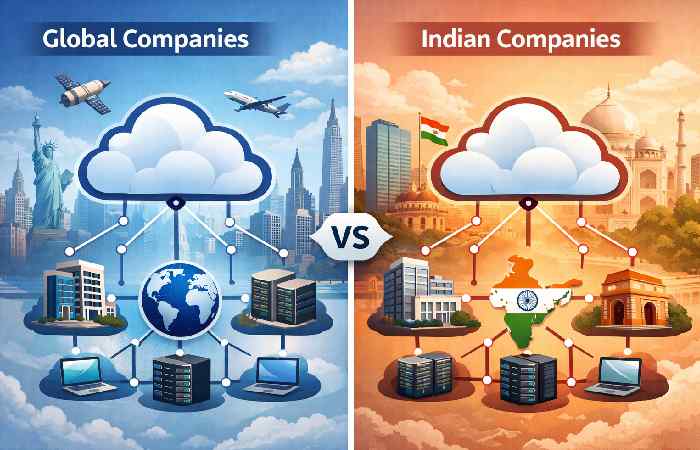
How These Companies Use Cloud Computing Architecture
- Data storage and management
- Real-time analytics and AI
- Global scalability of services
- Disaster recovery and backup
- SaaS product delivery
- Microservices architecture
- Content delivery (CDN)
- Automation and DevOps
- Secure data handling
- Multi-cloud deployment
Industry Comparison: Global vs India
| Industry | Global Leaders | Indian Leaders |
| IT Services | IBM | Tata Consultancy Services |
| Cloud Platforms | Amazon | Reliance Jio |
| SaaS | Salesforce | Freshworks |
| Telecom | AT&T | Bharti Airtel |
Key Insights
- Global companies dominate cloud infrastructure innovation
- Indian companies lead in cloud services and outsourcing
- SaaS and telecom sectors are the biggest adopters
- Hybrid and multi-cloud strategies are widely used
Future Trends in Cloud Computing Architecture
- Emerging Trends
- Serverless computing
- Edge computing
- AI integration
- Multi-cloud strategies
- Quantum computing
- Green cloud solutions
- Hybrid cloud dominance
- Automation with AI
- Cybersecurity advancements
- Industry-specific clouds
Cloud Computing Use Cases
| Industry | Use Case |
| Healthcare | Patient data storage |
| Finance | Fraud detection |
| Education | Online learning platforms |
| Retail | E-commerce systems |
| IT | Application hosting |
Conclusion
Cloud computing architecture is the foundation of modern IT systems, enabling scalability, flexibility, and innovation. By understanding its components, types, and management strategies, businesses and professionals can leverage cloud technologies effectively.
This guide has covered everything from basics to advanced concepts, ensuring complete knowledge for beginners and professionals alike.