



Data Technology refers to the systems that collect, process, analyze, and apply data to improve urban planning, infrastructure, and governance. In megacities, it combines:
- IoT sensors
- Big data analytics
- Cloud infrastructure
- AI modeling
- Predictive simulations
It transforms raw city activity into actionable intelligence.
Table of Contents
Data Technology Ecosystem of a Future Megacity
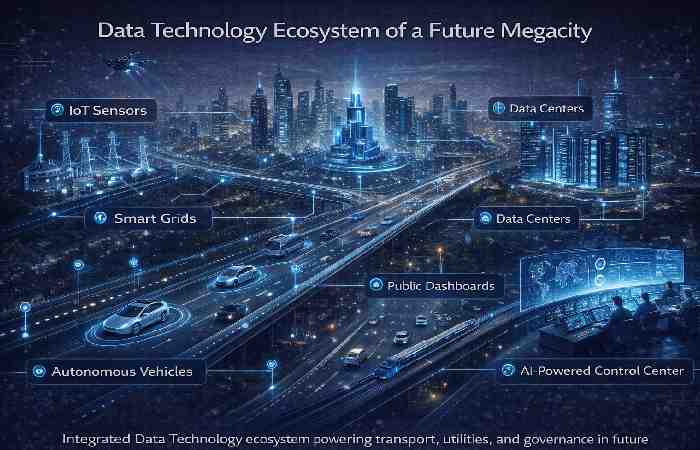
Data Technology: Where It Is Used Globally
| Sector / Industry | How Data Technology Is Used | Real-World Example | Key Benefits |
| Smart Cities | Traffic monitoring, smart lighting, waste management, surveillance | AI-powered traffic systems in Singapore | Reduced congestion, energy savings |
| Transportation | Route optimization, autonomous vehicles, predictive maintenance | Metro card data tracking systems | Improved mobility, fewer delays |
| Healthcare | Patient data analysis, telemedicine, predictive diagnostics | AI-driven disease detection systems | Faster diagnosis, personalized treatment |
| Retail & E-commerce | Customer behavior tracking, inventory forecasting, recommendation engines | Amazon recommendation algorithm | Increased sales, better customer experience |
| Finance | Fraud detection, risk assessment, algorithmic trading | AI-based banking fraud alerts | Improved security, faster transactions |
| Energy & Utilities | Smart grids, energy consumption monitoring | Smart meters in urban regions | Energy efficiency, reduced waste |
| Manufacturing | Predictive maintenance, supply chain analytics | IoT sensors in factories | Reduced downtime, cost efficiency |
| Education | Learning analytics, adaptive learning platforms | AI-based online learning systems | Personalized learning, improved outcomes |
| Agriculture | Crop monitoring, weather data analysis | Precision farming with IoT sensors | Higher yield, resource optimization |
| Security & Defense | Surveillance systems, cyber threat detection | AI-powered cybersecurity tools | Enhanced safety, threat prevention |
Global Urban Growth and the Role of Data Technology
By 2050, nearly 70% of the world’s population will live in cities (United Nations projection). This rapid expansion requires data-driven planning.
Urban Population Growth Projection
| Year | Global Urban Population | % of Total Population |
| 2020 | 4.4 Billion | 56% |
| 2030 | 5.2 Billion | 60% |
| 2040 | 6.0 Billion | 65% |
| 2050 | 6.7 Billion | 68–70% |
Without Data Technology, infrastructure planning would rely on outdated manual forecasting.
How Data And Technology Will Power The Megacities Of The Future
Data Technology What will cities look like in 2050 Will they be like those in South Korea, focused on a digital adaptation of existing society. Will they be similar to the spectacular new cities of Dubai or Singapore. Or will they be underground or under the oceans.
Today, innovative cities, such as Curitiba, in Brazil, are rethinking all public transport strategies while debating visions of autonomous vehicles and drones. The most basic infrastructure needs have always been focus on how people want to live and get around.
It’s also about how things move. expects e-commerce to grow 26% between 2016 and $ 2.4 trillion Globally in 2018, increasing pressure to upgrade roads, highways and port / airport infrastructure for vehicle use autonomous.
Add to that mix a myriad of technological disruptions, such as sensors, big data technology and the Internet of Things (IoT), that can help adjacent cities work together like the cogs of a larger machine.
Planners have taken into account the pressures of urbanization, often in areas with little space to Increase construction capacity or infrastructure.
An alternative is to analyze the data collected to Determine how to densify the population corridors between neighboring cities, with public transport Creating mega-regions that could easily house millions more. Some Wearables are there.
The challenge for cities around the world is: How to grow? How to operate and transform simultaneously?
Core Components of Data Technology in Megacities
Data Technology Infrastructure Layers
| Layer | Function | Example Application |
| IoT Sensors | Real-time monitoring | Traffic, water, air quality |
| Data Analytics Platforms | Process large datasets | Congestion prediction |
| Cloud Computing | Store & scale data | Smart grids |
| AI & Machine Learning | Predict & automate | Autonomous transport |
| Visualization Tools | Policy simulation | Urban planning models |
These layers work together to power transport, utilities, healthcare, and public safety.
Real-World Data Technology Use Cases
Smart City Data Technology Applications
| Sector | Data Technology Application | Impact |
| Transportation | Smart traffic systems | 20–30% congestion reduction |
| Energy | Smart grids | 15–25% energy savings |
| Water | Leak detection sensors | Reduced water loss |
| Security | AI surveillance | Faster response times |
| Urban Planning | Predictive modeling | Better zoning decisions |
Authoritative resource:
United Nations Smart Sustainable Cities Initiative
https://unece.org/housing/smart-sustainable-cities
Data and the megalopolises of the future
Neighboring cities come together in their common infrastructure and the mutual impact of their economies. Power lines, roads, traffic, water systems and security don’t stop at city limits, and municipalities are facing transformation at an unprecedented rate. As a result, there is a lot of debate about who decides which way to go and what it looks like.
When it comes to designing infrastructure, one thing is certain: Big data collected via IoT will play a key role in the growth of mega-cities by 2050.
Big data is all the information that surrounds us and is collect in various streams. Says Steph Stop , business development manager for smart cities at Black & Veatch. “If you use a metro card to take the metro, the system knows when you’ve entered. Where you’ve gone and which route you’ve taken.
How is this useful? Because it helps you recognize if the metro service is working. Was it successful? Yes It was, you will do it over and over again. This is an example of using data to observe the movement of people, creating smarter mobility.
However, not all data is easily translated into useful or accurate information. To cope with the changing urban landscape, information itself must be seen as a form of infrastructure And also, which can be used for better planning to connect cities within a larger system.
The starting point is people, not technology. Planning, design and investment decisions, as well as supporting policy formulation, can be informed and accelerated through visualization, simulation and analysis of infrastructure.
The emergence of big data and advanced modeling technologies make it possible to plan. And prioritize infrastructure investments with greater foresight. Better communicate potential outcomes and achieve better results.
Cost of Data Technology Infrastructure in Top 5 Countries
Below is an estimated comparison of smart city Data Technology investments and commonly used digital platforms.
| Country | Avg Smart City Budget (Annual) | Data Platforms Used | Public Digital Access |
| USA | $2–5 Billion (major cities) | AWS GovCloud, Microsoft Azure | High |
| China | $3–6 Billion | Alibaba Cloud, Huawei Cloud | Very High |
| Singapore | $1–2 Billion | GovTech SG, AWS | Very High |
| UAE | $1–3 Billion | Smart Dubai Platform | High |
| South Korea | $1–2 Billion | National Smart City Data Hub | Very High |
Estimated Cost Per Citizen (Urban Tech Investment)
| Country | Approx Cost Per Citizen |
| USA | $300–$600 |
| China | $250–$500 |
| Singapore | $800–$1,200 |
| UAE | $700–$1,100 |
| South Korea | $500–$900 |
These costs reflect infrastructure deployment, IoT networks, cloud systems, and analytics platforms.
Creating smart cities
cities means more than using IoT to optimize services or communicate information to residents. It should be a construct used to frame local government decision making around city transformation. While 2050 seems far away, but for existing cities that need to keep functioning while transforming. And competing with new cities, that date seems closer. Cities must evolve in order to develop in a sustainable manner; improve resilience; meet the growing expectations of citizens; and attract investment, startups and talent. The good news is that data and technology will improve work and life by creating a well-connected community. And we know some information about Botnet.
Data Technology Types: Leading Countries, Usefulness & Global Trends
| Data Technology Type | What It Does | Leading Country Using It | Why That Country Leads | Most Useful For | Trending Level (2026) |
| Artificial Intelligence (AI) | Automates decisions, predicts outcomes, powers smart systems | United States | Strong tech ecosystem, big tech investment | Smart cities, healthcare, finance | Very High |
| Internet of Things (IoT) | Connects physical devices to collect and share data | China | Massive infrastructure & smart manufacturing scale | Smart homes, smart factories, urban mobility | Very High |
| Big Data Analytics | Processes massive datasets for insights | India | Large IT workforce & digital services growth | Banking, telecom, e-governance | High |
| Smart City Platforms | Integrated urban data management systems | Singapore | National smart nation initiative | Urban planning, transport, security | Very High |
| 5G & Edge Computing | Real-time data processing at network edge | South Korea | Advanced telecom infrastructure | Autonomous vehicles, AR/VR, IoT | High |
| Blockchain Technology | Secure decentralized data systems | Estonia | Digital government infrastructure | Digital identity, finance, governance | Growing |
| Cloud Computing | Remote storage & scalable data services | Germany | Strong enterprise cloud adoption | Business operations, startups | Very High |
| Digital Twin Technology | Virtual simulation of physical infrastructure | United Arab Emirates | Smart city mega-project investments | Urban development, construction | Trending |
Benefits and Challenges of Data Technology in 2050 Cities
Expected Benefits of Data Technology
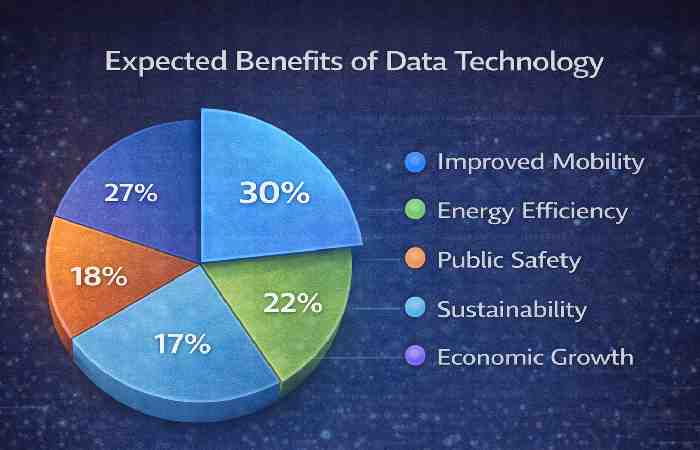
| Benefit | Share |
| Improved Mobility | 30% |
| Energy Efficiency | 22% |
| Public Safety | 18% |
| Sustainability | 17% |
| Economic Growth | 13% |
Key Challenges
- Data privacy concerns
- Cybersecurity risks
- High infrastructure costs
- Policy and governance gaps
- Digital inequality
Conclusion
Data Technology will not simply support megacities — it will define them. From autonomous mobility systems to AI-powered infrastructure modeling, cities of 2050 will depend on continuous data collection and intelligent decision-making systems.
The transformation requires investment, governance clarity, and citizen trust. But when implemented effectively, Data Technology enables cities to grow sustainably, operate efficiently, and remain resilient in the face of rapid urban expansion.