


Hyperscale data describes computing architectures that provide extreme scalability for processing, storage, and retrieval, and network throughput without performance limitations. It is essential for the performance and functionality of cloud computing, artificial intelligence, streaming technologies, and digital services. Instead of upgrading individual units, hyperscale architectures are designed to be enlarged by the addition of, potentially, thousands of units through automated and distributed computing.
Table of Contents
What Is Hyperscale Data?
Its environments are built to:
| Capability | Description |
| Massive Data Handling | Petabytes to exabytes of storage |
| High User Capacity | Millions of users simultaneously |
| Auto Scaling | Expands or reduces automatically |
| High Availability | 99.99%–99.999% uptime |
| Intelligent Automation | AI-based monitoring |
Major hyperscale operators include Amazon, Microsoft, Google, Meta, Alibaba, and Tencent.
Hyperscale Data environments are designed to handle unpredictable demand. They automatically adjust resources based on traffic and workload. This makes them ideal for modern digital services.
Unlike traditional systems, Hyperscale Data focuses on distributed computing. Instead of relying on a single powerful machine, it uses thousands of smaller units working together. This improves reliability and reduces failure risks.
Key Characteristics
- Designed for massive scalability
- Built with distributed architecture
- Supports global applications
- Ensures continuous availability
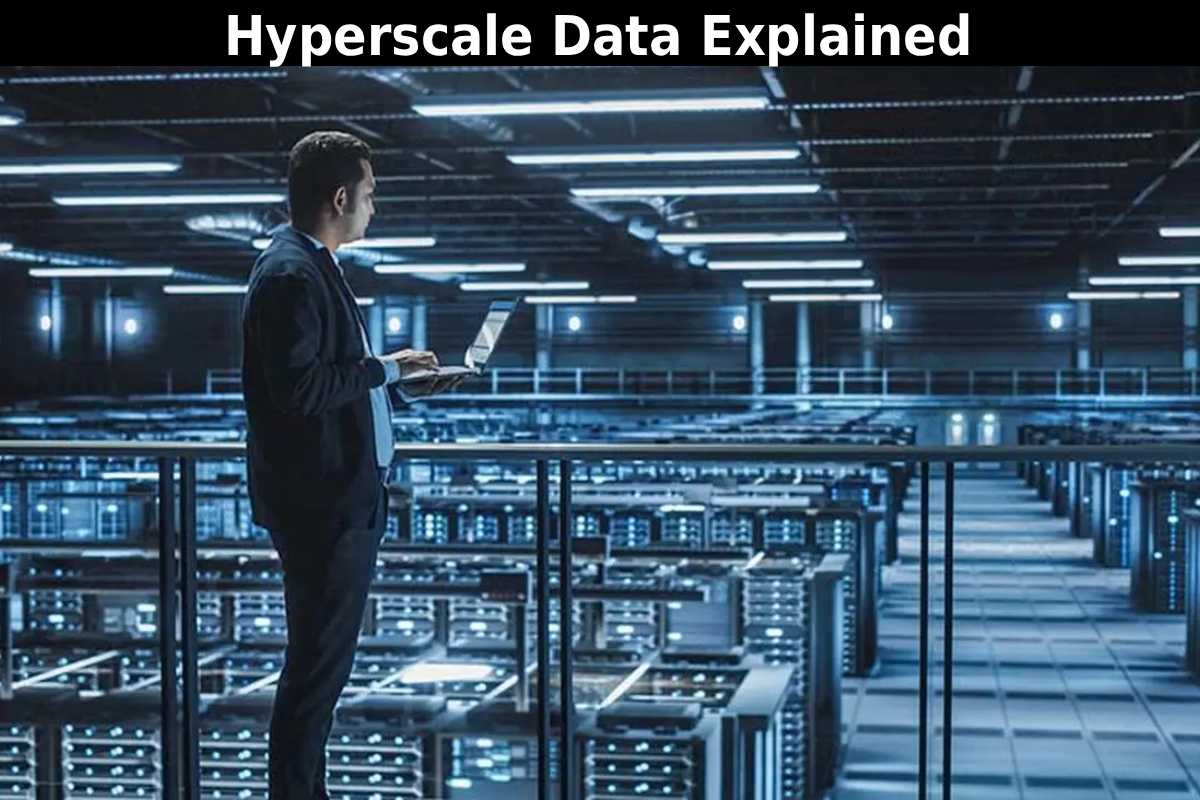
Hyperscale Data Center
It is a large facility engineered to support hyperscale computing.
Hyper-scale Data Center Specifications
| Parameter | Hyperscale | Traditional |
| Server Count | 5,000+ | 100–1,000 |
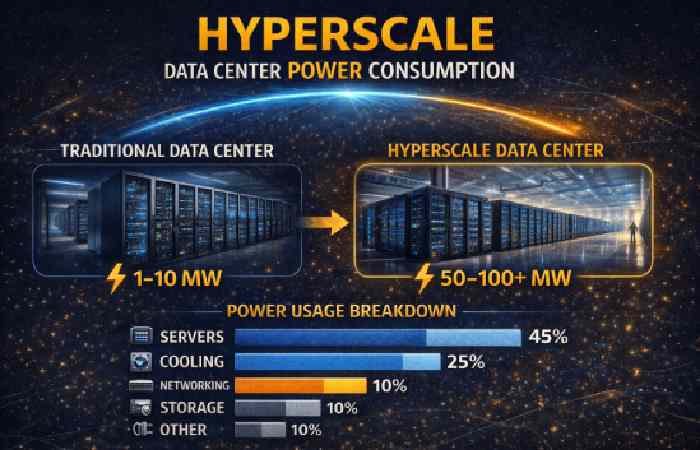
| Power Capacity | 50MW–100MW+ | 1–10MW |
| Space | 100,000+ sq ft | 10,000–30,000 sq ft |
| Cooling | Liquid + AI optimized | Air-based |
| Uptime | 99.999% | 99–99.9% |
A Hyperscale Data center is not just larger in size. It is also smarter and more efficient. These facilities use automation to manage workloads and reduce downtime.
They are often located in strategic regions. This helps deliver faster services to users worldwide.
Why Size Matters
- Supports millions of users
- Handles large-scale AI workloads
- Reduces latency globally
Core Infrastructure Layers
| Layer | Technology Used | Purpose |
| Compute | GPU/CPU clusters | AI & cloud processing |
| Storage | Distributed object storage | Big data handling |
| Networking | SDN, fiber backbone | High-speed transfer |
| Orchestration | Kubernetes | Auto scaling |
| Monitoring | AI-based analytics | Failure prediction |
Each layer in a Hyperscale Data system plays a critical role. Compute handles processing, while storage manages vast datasets. Networking ensures fast communication between systems.
Orchestration tools like Kubernetes automate scaling. Monitoring systems detect failures before they happen. This creates a highly reliable ecosystem.
Hyperscale Data Center Companies Worldwide
It is dominated by global tech giants. These companies build and operate massive infrastructure across continents. Their facilities power cloud computing, artificial intelligence, and global applications.
Global Hyperscale Operators
| Company | Region | Key Services | Data Center Count |
| Amazon (AWS) | Global | Cloud Computing | 100+ |
| Microsoft (Azure) | Global | Enterprise Cloud | 200+ |
| Google Cloud | Global | AI & Data Services | 40+ |
| Meta | US, Europe, Asia | Social Platforms | 20+ |
| Alibaba Cloud | China, Asia | E-commerce Cloud | 30+ |
| Tencent Cloud | Asia | Gaming & Cloud | 25+ |
These companies drive the growth of it by investing billions annually.
Key Global Expansion Regions
- North America: Mature infrastructure
- Europe: Green data initiatives
- Asia-Pacific: Fastest growth
- Middle East: Government-backed expansion
Hyperscale Data Center vs Traditional Data Center
| Feature | Traditional | Hyperscale |
| Scaling Method | Upgrade hardware | Add server nodes |
| Performance | Limited under load | Handles massive spikes |
| Automation | Manual | Software-defined |
| Cost at Scale | Higher | Lower due to efficiency |
| Reliability | Moderate | Very high |
Metric Comparison: Scalability, Automation, Efficiency, Reliability
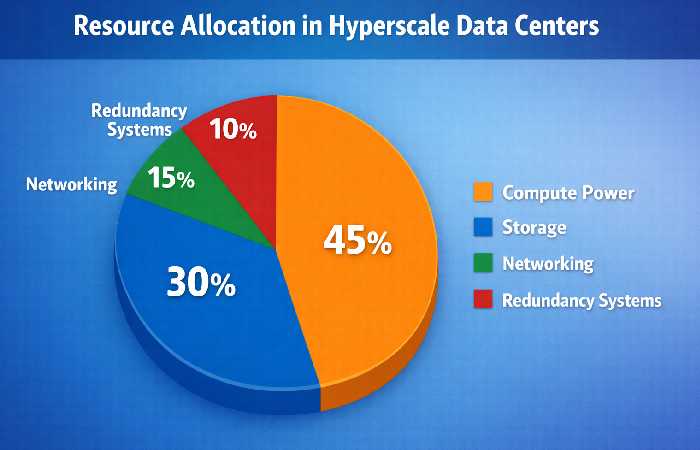
Resource Allocation In Hyperscale Data Centers
Cost Structure of Hyperscale Data Centers
| Cost Component | Estimated Share |
| Construction | 35% |
| Servers & Hardware | 30% |
| Power & Cooling | 20% |
| Networking | 10% |
| Security & Compliance | 5% |
It facilities require billions in capital investment but achieve long-term operational efficiency.
Hyperscale Data Benefits
| Benefit | Impact |
| Dynamic Scalability | Instant demand adjustment |
| High Reliability | Near-zero downtime |
| Energy Optimization | Low PUE (1.1–1.3 typical) |
| Automation | Reduced human error |
| Cloud Integration | Seamless global services |
Visual: Hyperscale Data Center Power Consumption
Hyperscale Data Market Growth
| Year | Market Size (USD Billion Est.) |
| 2022 | 60 |
| 2023 | 75 |
| 2024 | 90 |
| 2025 | 110 |
| 2026 | 135 |
| 2027 | 160 |
| 2028 | 190 |
Growth is driven by AI workloads, cloud expansion, 5G, IoT, and digital transformation.
The rapid growth of it is driven by increasing data consumption. Technologies like AI, IoT, and 5G are generating massive datasets.
Companies are investing heavily to meet this demand and stay competitive.
Top 10 Hyperscale Data Center Locations Worldwide
These facilities represent the largest Hyperscale Data hubs globally.
| Data Center | Location | Address | Contact |
| Equinix DC1 | Ashburn, USA | 21715 Filigree Ct | +1-855-886-3669 |
| Digital Realty | Dallas, USA | 2323 Bryan St | +1-214-754-7500 |
| Google Data Center | Hamina, Finland | Summa, Finland | N/A |
| Microsoft Azure | Dublin, Ireland | Grange Castle | N/A |
| AWS | Oregon, USA | Boardman | N/A |
| Alibaba Cloud | Hangzhou, China | Alibaba Campus | N/A |
| Tencent | Shanghai, China | Pudong | N/A |
| NTT | Tokyo, Japan | Tokyo Campus | +81-3-6733-9000 |
| Equinix LD8 | London, UK | Slough | +44-20-7950-9000 |
| Digital Realty | Frankfurt, Germany | Hanauer Landstrasse | +49-69-5050-8000 |
These hubs support global it traffic and digital services.
These locations are chosen based on connectivity, power availability, and climate conditions. Cooler regions help reduce cooling costs.
Global connectivity ensures faster data delivery across continents.
Top 5 Hyperscale Data Centers in India
India is a fast-growing market for it due to digital transformation.
| Data Center | City | Address | Contact |
| Yotta NM1 | Navi Mumbai | Panvel | +91-22-6210-0000 |
| CtrlS | Hyderabad | Hitech City | +91-40-4200-3030 |
| STT GDC | Chennai | SIPCOT IT Park | +91-44-6600-8000 |
| NTT Chennai | Chennai | Ambattur | +91-44-6631-9000 |
| AdaniConneX | Noida | Sector 62 | +91-120-686-0000 |
India’s Hyperscale Data growth is driven by cloud adoption and 5G expansion.
India is emerging as a major Hyperscale Data hub. Government initiatives and increasing internet usage are driving growth.
The demand for cloud services and digital platforms continues to rise rapidly.
Top Hyperscale Data Trends (2026 & Beyond)
| Trend | Development |
| AI Integration | AI-driven operations |
| Green Energy | Solar & wind powered facilities |
| Liquid Cooling | Advanced thermal management |
| Modular Expansion | Faster deployment |
| Edge Hyperscale | Low latency processing |
| Asia Growth | India & Indonesia expansion |
Hyperscale Data Center Use Cases
| Industry | Application |
| AI & ML | Large model training |
| Cloud Services | SaaS & IaaS |
| Streaming | Global content delivery |
| Finance | High-frequency trading |
| Healthcare | Genomic data processing |
| IoT | Billions of device connections |
Hyperscale Data Center vs Data Center
| Feature | Traditional | Hyperscale Data |
| Scalability | Limited | Unlimited |
| Automation | Manual | Fully automated |
| Cost Efficiency | High | Optimized |
| Performance | Moderate | Extremely high |
| AI Integration | Minimal | Advanced |
It enables faster scaling and better efficiency.
Hyperscale Data Stock
When people search it, they are looking for companies benefiting from hyperscale expansion.
Types of Companies Linked to Hyperscale Data Stock
| Category | Examples | Role |
| Cloud Providers | AWS, Azure, Google | Operate centers |
| REITs | Equinix, Digital Realty | Lease facilities |
| Chip Makers | Nvidia, AMD, Intel | AI hardware |
| Networking | Cisco, Arista | Data transmission |
| Cooling Systems | Vertiv, Schneider | Power & cooling |
Growth Drivers
| Driver | Impact |
| AI Boom | GPU demand surge |
| Cloud Migration | Infrastructure growth |
| Data Explosion | Storage expansion |
| Government Digitalization | National investments |
Investment Risks
| Risk | Explanation |
| Energy Costs | High electricity usage |
| Regulation | Data sovereignty laws |
| Competition | Market saturation |
| Economic Cycles | Reduced IT spending |
Hyperscale Data Stock & Investment Insights
Investors are focusing on it due to rapid growth.
Top Stocks Linked
| Company | Sector | Growth Driver |
| NVIDIA | GPUs | AI demand |
| AMD | Chips | Data processing |
| Intel | CPUs | Enterprise |
| Equinix | REIT | Data centers |
| Digital Realty | REIT | Leasing |
Key Investment Insights
- AI is increasing GPU demand
- Cloud adoption is expanding globally
- Governments are investing in digital infrastructure
Hyperscale Data Center News Today
Current center news today typically includes:
| Topic | Coverage Focus |
| AI Investments | Multi-billion dollar expansions |
| Renewable Power Deals | Carbon neutrality commitments |
| Regional Expansion | Asia & Middle East growth |
| Regulatory Policies | EU & US compliance updates |
| Strategic Partnerships | Tech & energy collaborations |
Hyperscale Data Center News
Long-term hyper scale data center news trends:
| Region | Growth Direction |
| North America | Mature but expanding |
| Europe | Green infrastructure focus |
| Asia-Pacific | Fastest growing |
| Middle East | Government-backed |
| Africa | Emerging digital hubs |
Challenges of Hyperscale Data Centers
| Challenge | Explanation |
| Power Consumption | Massive electricity demand |
| Cooling Requirements | Advanced liquid systems needed |
| Environmental Impact | Carbon & water concerns |
| Land Usage | Large campus size |
| Data Compliance | Regional laws |
Hyperscale Data News & Global Insights
It is evolving rapidly due to AI and cloud expansion.
Resource 1:
https://www.statista.com/topics/7675/data-centers/
Global News Trends
| Region | Trend |
| USA | AI expansion |
| Europe | Green energy |
| Asia | Rapid growth |
| Middle East | Smart cities |
Industries Powered by Hyperscale Data
It supports multiple industries globally.
Industry Impact Table
| Industry | Use Case |
| E-commerce | Real-time transactions |
| Gaming | Cloud gaming |
| Banking | Fraud detection |
| Healthcare | Data analysis |
| Telecom | 5G networks |
Key Benefits
- Faster services
- Better scalability
- Improved reliability
Future of Hyper Scale Data
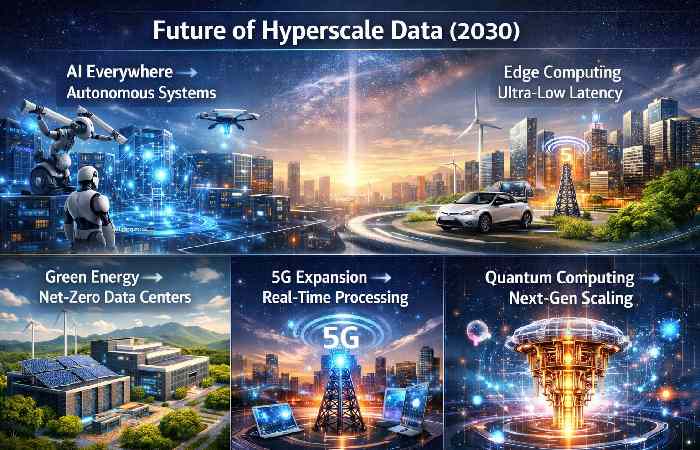
Hyperscale infrastructure will expand due to:
| Growth Factor | Influence |
| AI Workloads | Increased compute demand |
| Edge Computing | Local processing needs |
| 5G Networks | Real-time apps |
| Cloud Adoption | Enterprise migration |
| Digital Economies | Global transformation |
By 2030, hyperscale systems are expected to dominate enterprise computing infrastructure worldwide.
Final Takeaway
The extreme scalability, automation, operational efficiency, and distributed architecture of hyperscale data centers empower the digital world to function seamlessly, and efficiently, at an unprecedented scale. It is an important technology sector that impacts everything from the design of computing infrastructures to stock market investment options. It is one of the most important technology sectors that is expanding the frontiers of computing.