

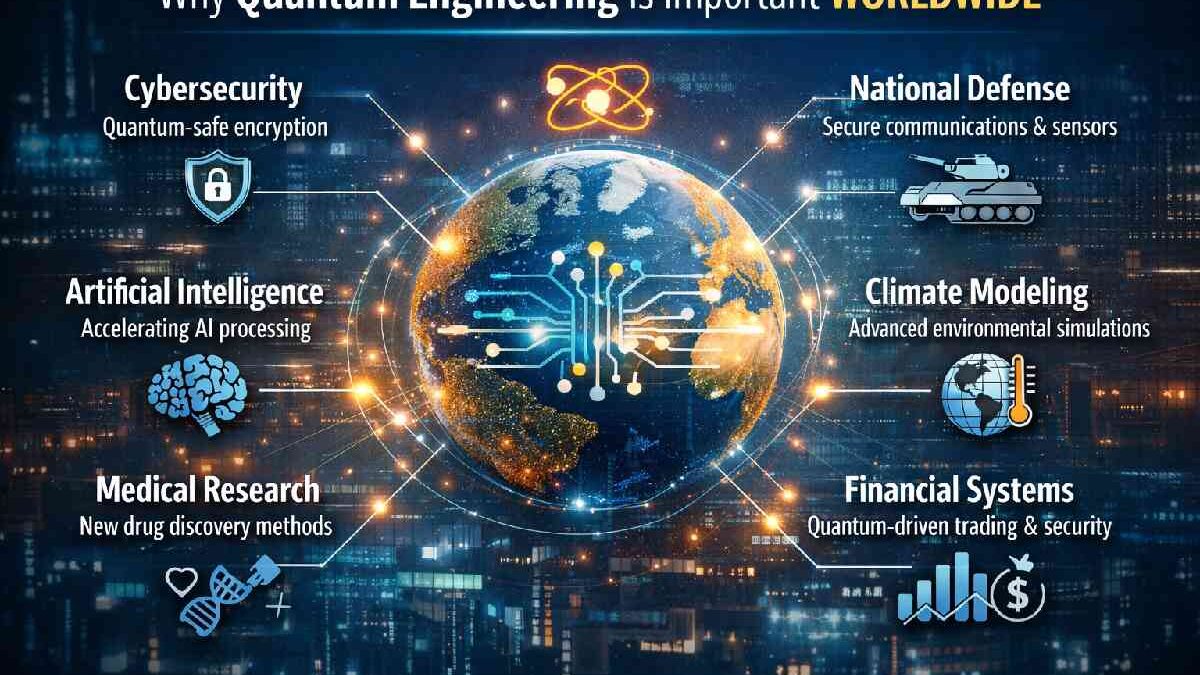
Quantum engineering combines different fields and uses the principles of quantum physics to design and fabricate technologies that work in the real world. Within the realms of quantum computing, quantum sensing, and quantum communication, it unites several disciplines, including physics, electronic engineering, computer science, and materials science.
This guide covers everything regarding quantum engineering, from the elementary principles to the latest global research, practical applications, industry standards, and career opportunities.
Table of Contents
What Is Quantum Engineering?
Quantum engineering is an applied engineering discipline that designs and builds technologies using quantum mechanics principles such as superposition and entanglement.
Unlike theoretical quantum physics, quantum engineering focuses on:
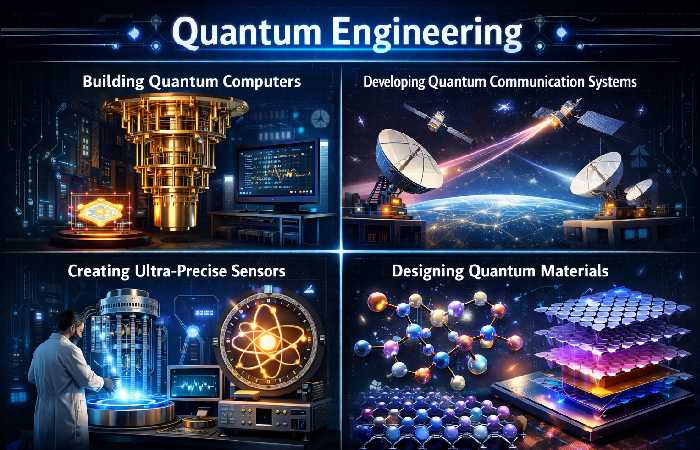
It combines:
| Field | Contribution |
| Physics | Quantum theory |
| Electrical Engineering | Circuit design |
| Computer Science | Algorithms |
| Materials Science | Quantum materials |
| Mathematics | Linear algebra & probability |
In simple terms, it turns quantum science into usable technology.
Core Principles Behind Quantum Engineering
Understanding it requires grasping key principles:
Superposition
This system can exist in multiple states at the same time.
Entanglement
Two particles continue connected even when separated by large distances.
Quantum Interference
Quantum states combine to intensify or cancel probabilities.
Decoherence
Loss of quantum behavior due to environmental interference—one of the main engineering challenges.
Resource:
National Institute of Standards and Technology (NIST) Quantum Information
https://www.nist.gov/congressional-and-legislative-affairs/fy-2007-budget-request-details/quantum-information-science
Major Areas of Quantum Engineering
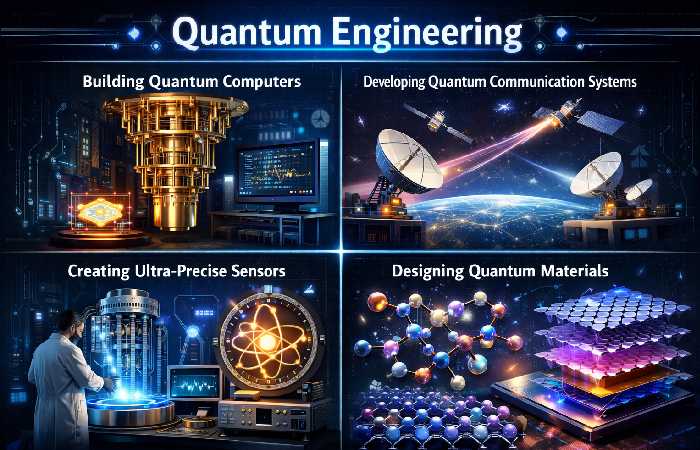
It spans multiple specialized domains.
| Area | Description | Example Applications |
| Quantum Computing | It is qubit-based processors | Cryptography, AI |
| Quantum Communication | It secure data transmission | Quantum internet |
| Quantum Sensing | Help in ultra-precise measurement | Medical imaging |
| Quantum Materials | It exotic material design | Superconductors |
| Quantum Photonics | It is light-based quantum systems | Fiber networks |
What is Quantum Computing Engineering
Quantum computing is one of the most advanced areas of it.
How It Works
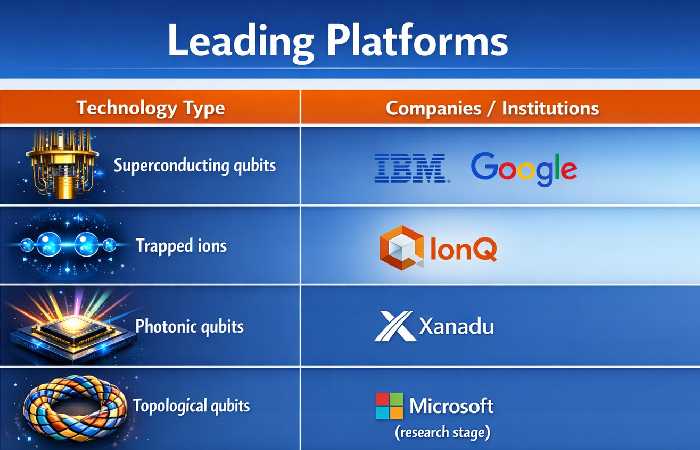
Instead of bits, quantum computers use qubits that can exist in superposition. Entangled qubits allow exponential computational power.
Leading Platforms
What is Quantum Communication Engineering
Quantum communication enables theoretically unbreakable encryption using Quantum Key Distribution (QKD).
Key Feature:
If someone intercepts quantum data, the quantum state changes—making detection possible.
Applications:
- Government security
- Financial data protection
- Military communication
Advanced Applications in Quantum Sensors and Metrology
Quantum sensors use quantum properties to achieve extremely high precision.
| Sensor Type | Use Case |
| Atomic clocks | GPS systems |
| Magnetometers | Brain imaging |
| Gravimeters | Underground mapping |
| Quantum accelerometers | Aerospace navigation |
Key Quantum Engineering Applications
It is not just theoretical. Real-world uses include:
- Healthcare
- Advanced MRI
- Molecular simulation for drug discovery
- Finance
- Risk modeling
- Portfolio optimization
- Climate Science
- Climate modeling simulations
- Material discovery for renewable energy
- Artificial Intelligence
- Quantum-enhanced machine learning
- Logistics
- Route optimization
- Supply chain efficiency
Quantum Engineering in Emerging Economies
Emerging markets are investing in quantum research to avoid technological dependency.
Why Emerging Countries Are Investing
- National security
- Innovation ecosystems
- Economic competitiveness
- Digital independence
- Talent development
Countries Expanding Research
| Country | Focus |
| India | Quantum communication & computing |
| Brazil | Academic quantum research |
| South Korea | Quantum hardware |
| UAE | AI + quantum strategy |
These investments show it is becoming globally strategic.
Engineering Challenges in Quantum Systems
It faces serious obstacles.
| Challenge | Explanation |
| Decoherence | Environmental noise disrupts qubits |
| Scalability | Building millions of stable qubits |
| Error Correction | High quantum error rates |
| Cryogenic Cooling | Systems require near absolute zero |
| Cost | Extremely expensive infrastructure |
Regulatory and Standardization Efforts Globally
As it advances, international standards are being developed to ensure security and interoperability.
Key Organizations
| Organization | Role |
| NIST (USA) | Post-quantum cryptography standards |
| ISO | International standard frameworks |
| ETSI (Europe) | Quantum communication standards |
| ITU | Global telecom integration |
Standardization ensures global compatibility for future quantum networks.
Quantum Engineering vs Quantum Physics
| Quantum Physics | Quantum Engineering |
| Theoretical science | Applied engineering |
| Studies quantum laws | Builds quantum devices |
| Academic research | Industrial innovation |
| Focus on equations | Focus on prototypes |
It translates theory into usable technology.
Global Investment and National Initiatives
Governments worldwide are investing heavily.
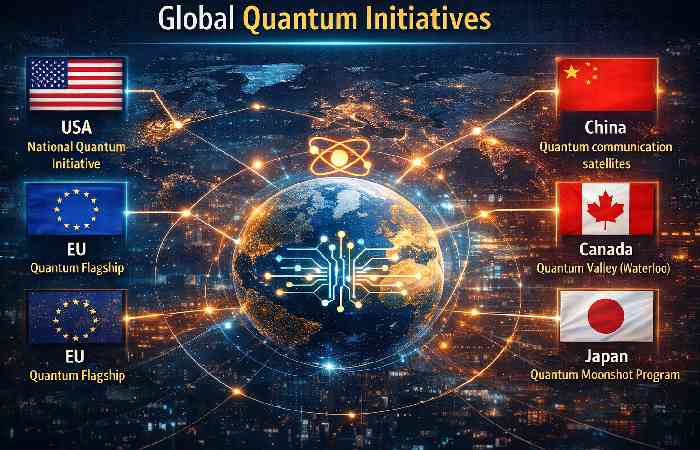
Quantum Engineering Around the World
Its development is not limited to one country. It is a global race involving research institutions, private companies, and governments.
Regional Development Overview
| Region | Focus Area | Growth Level |
| North America | Quantum computing & startups | Very High |
| Europe | Secure communication & standards | High |
| China | Quantum satellites & infrastructure | Very High |
| Canada | Quantum research ecosystem | High |
| Japan | Industrial quantum applications | Medium–High |
| Australia | Quantum sensing & materials | Growing |
| India | Academic research & policy push | Emerging |
Each region has different strengths depending on funding, research capacity, and strategic goals.
Education and Career Path in Quantum Engineering
- Required Background
- Physics
- Electrical Engineering
- Computer Science
- Mathematics
Typical Degrees
| Degree | Focus |
| Bachelor’s | Physics / EE |
| Master’s | Quantum technology |
| PhD | Quantum research |
Career Roles
| Role | Industry |
| Quantum Hardware Engineer | Tech companies |
| Quantum Algorithm Developer | AI research |
| Quantum Software Engineer | Startups |
| Cryogenic Systems Engineer | Hardware labs |
| Quantum Research Scientist | Universities |
Top Universities:
- MIT
- Stanford
- University of Waterloo
- ETH Zurich
- Oxford
MIT Quantum Engineering:
https://quantum.mit.edu/
International Career Opportunities
Quantum engineers are in demand worldwide.
Industries Hiring Globally
| Sector | Examples |
| Big Tech | Quantum hardware & cloud services |
| Aerospace | Navigation & sensing |
| Defense | Secure communication |
| Finance | Optimization modeling |
| Healthcare | Drug discovery simulations |
Quantum Engineering Jobs
Its jobs are growing globally in research labs, startups, and large technology companies.
Common Job Roles
| Role | Description |
| Quantum Hardware Engineer | Designs qubit systems |
| Quantum Software Engineer | Develops quantum algorithms |
| Quantum Research Scientist | Conducts advanced research |
| Cryogenic Engineer | Maintains cooling systems |
| Quantum Systems Architect | Integrates hardware and software |
Industries Hiring
- Big Tech companies
- Defense and aerospace
- National research labs
- Quantum startups
- Financial modeling firms
Many positions require advanced degrees due to the complexity of the field.
Quantum Engineering Salary
It is one of the highest-paying emerging technology fields due to its technical complexity and limited talent pool.
Global Salary Overview (Approximate)
| Region | Senior/PhD | Entry Level | Mid-Level |
| Europe | $150,000+ | $70,000 | $100,000 |
| Asia | $130,000+ | $50,000 | $85,000 |
| United States | $180,000+ | $95,000 | $130,000 |
| Canada | $160,000+ | $80,000 | $115,000 |
Salary Depends On:
- Education level (Master’s vs PhD)
- Hardware vs software specialization
- Government vs private sector
Research vs product engineering
Quantum engineers working in quantum computing startups or major tech firms typically earn higher compensation packages.
Quantum Engineering Tools and Technologies
Engineers use specialized tools.
| Tool | Purpose |
| Qiskit | Quantum programming (IBM) |
| Cirq | Google’s quantum framework |
| Cryostats | Ultra-cold cooling |
| Nanofabrication tools | Chip manufacturing |
| Laser systems | Ion trapping |
Ethical and Security Considerations
Quantum computing may:
- Break classical encryption (RSA)
- Disrupt cybersecurity systems
- Shift global power balances
Governments are preparing post-quantum cryptography.
Future of Quantum Engineering
Experts predict:
- Quantum advantage in niche tasks within 5–10 years
- Commercial hybrid quantum-classical systems
- Quantum cloud services
- Development of a quantum internet
However, fully fault-tolerant quantum computers may take decades.
Frequently Asked Questions
Is it hard?
Yes. It requires advanced mathematics, physics, and engineering knowledge.
Is quantum engineering the future?
It is expected to transform computing, sensing, and secure communication.
Does this engineering replace classical computing?
- No. It complements classical systems for specific problems.
- Ethical, Geopolitical, and Global Security Implications
- It could reshape global power dynamics.
Key Concerns
- Breaking traditional encryption systems
- Military advantages
- Data privacy risks
- Global technology divide
Governments are accelerating post-quantum security strategies to prevent cyber threats.
Final Thoughts
The field of quantum engineering applies quantum theory to practical purposes. It is at the forefront of technological development and has the potential to transform computing, cybersecurity, medicine, finance, and materials science.
Although there are still issues with scalability and error correction, the world is banking on quantum engineering to exhibit significant advancement in the coming years, as evidenced by the rapid global investments and research.
This guide covers the principles, technologies, applications, and challenges of it, and helps the reader understand the impact of it on the future of advanced technology.