


Pragmatic Marketing is a market-driven product strategy approach that ensures businesses build solutions customers truly need. When applied to AI development, pragmatic marketing aligns artificial intelligence investments with real customer demand, profitability, and measurable outcomes.
With the global AI market projected to exceed $260 billion by 2027, companies must combine AI development strategy + pragmatic marketing principles to succeed.
Table of Contents
The Pragmatic Marketing Framework for AI Products
Why Pragmatic Marketing Matters in AI App Development
AI projects fail not because of technology — but because of poor market alignment.
Key Benefits of Using Pragmatic Marketing in AI:
- Reduces product-market mismatch
- Validates demand before heavy development
- Improves ROI predictability
- Aligns sales, product, and marketing teams
- Minimizes wasted AI infrastructure cost
What is Pragmatic Marketing
There is a very sophisticated marketing approach and is often defined as a product creation process that continually adapts base on past marketing experience. This adaptation process includes testing the marketing strategy and re-adapting to ensure that the product is relevant and meets customer expectations.
Pragmatic Marketing vs Traditional Marketing
Pragmatic Marketing differs from traditional marketing in several ways:
| Aspect | Pragmatic Marketing | Traditional Marketing |
| Focus | Market problems first | Product features first |
| Approach | Data-driven validation | Campaign-driven promotion |
| Development | Iterative and adaptive | Linear and fixed |
| Customer Role | Active feedback loop | Passive buyer |
While traditional marketing emphasizes promotion, Pragmatic Marketing emphasizes product-market fit before promotion.
The Specific Requirements Of The Athlete.
Pragmatic marketing aims to carry out a series of tests and adaptations to ensure that the final product or service best suits the target audience’s requirements. For example, if a particular shoe company is creating a feature-specific shoe targeted at athletes, it would implement pragmatic marketing by testing the shoe with a sample group of athletes and then re-fitting the shoe to fit.
The Pragmatic Marketing Methodology
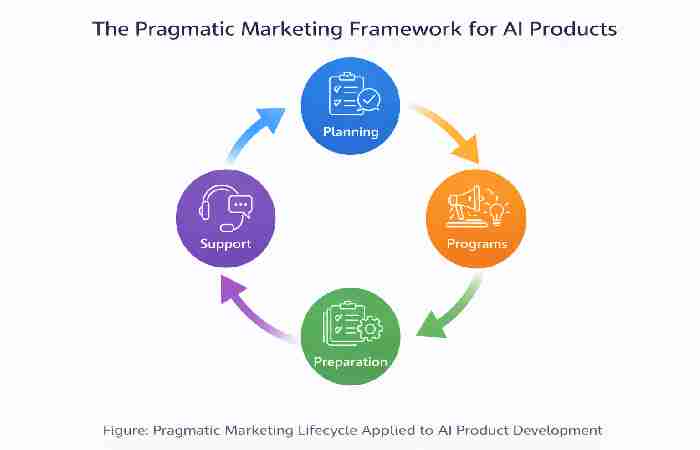
The pragmatic marketing methodology provides a standardize platform for the critical activities that are required to create products and services the profitable for a given organization. The following are the parts that make up the pragmatic marketing methodology:
Planning
This step aims to describe the various features and functionalities of a given product. In addition, the purchase process, which includes conducting research and documenting the purchasing processes of target market. Segments, is done here. The buy and use personas are also describ in this step. These are members of the target market that signify the ideal characteristics of the customers for a given product.
Planning Activities in AI Pragmatic Marketing
| Activity | Purpose |
| Market research | Identify opportunity |
| Persona mapping | Define buyer |
| Value proposition design | Clarify benefit |
| Revenue modeling | Forecast return |
Resource: McKinsey AI research insights
https://www.mckinsey.com/capabilities/quantumblack/our-insights
Programs
This step involves developing a marketing plan that communicates strategies for creating awareness for upcoming products. It also requires customer acquisition and retention initiatives that aim to define the budgets. And Schedules that will use to ensure that customers buy the product. And also become loyal customers of the product in the future.
AI Product Go-To-Market Strategy
| Program Type | Goal |
| Product launch campaign | Awareness |
| Sales enablement | Conversion |
| Content marketing | Education |
| Retention strategy | Loyalty |
Preparation
It aims to identify your organization’s sales processes by identifying the ways your target market prefers to buy your product. This step also involves developing tools for the sales department. These tools are plan to use in different parts of the sales process. Finally, the preparation aims to offer programs that can help the sales force to sell the product effectively.
- Sales toolkits
- Demo environments
- Pricing models
- ROI calculators
Support
This step involves developing demos and presentations. These aim to produce product presentations and standardize demos and can use across multiple marketing initiatives. Event support is also include in this step and is intend to provide market insight. For events such as trade shows, webinars, and conferences.
Post-Launch Support Metrics
| Metric | Why It Matters |
| Customer adoption rate | Product-market fit |
| AI accuracy | Performance quality |
| Retention rate | Long-term revenue |
| Feature usage | Roadmap decisions |
Pragmatic Marketing in AI App Development
When building an AI business application, pragmatic marketing aligns each technical step with business value.
Plan Your AI Application
Define:
- What business problem you are solving
- Expected ROI
- Required datasets
- Compliance requirements
Install an Advanced Container Registry
Enterprise AI apps often use containerization for scalability. Tools from JFrog support container registry management and secure deployments.
| Container Feature | Business Benefit |
| Secure Repository | Protect AI models |
| Scalable Storage | Handle large datasets |
| CI/CD Integration | Faster deployments |
| Kubernetes Support | Enterprise scalability |
Choose AI & ML API Solutions
| API Capability | Use Case |
| Image Recognition | Facial detection apps |
| NLP Processing | Chatbots |
| Sentiment Analysis | Customer feedback systems |
| Predictive Analytics | Sales forecasting |
Select the Right Algorithm
| Algorithm Type | Best For | Example |
| Supervised Learning | Labeled data problems | Loan approval system |
| Unsupervised Learning | Pattern detection | Customer segmentation |
| Reinforcement Learning | Adaptive systems | Smart assistants |
Develop a Minimum Viable Product (MVP)
| MVP Feature Strategy | Why Important |
| Focus on Core Features | Reduce cost |
| Test with Early Users | Validate demand |
| Measure Engagement | Improve retention |
| Iterate Quickly | Increase product-market fit |
Global Market Insights (Top 5 Countries for AI & Product Innovation)
| Country | AI Market Growth | Business Adoption Rate | Key Platforms |
| USA | Very High | Enterprise & Startups | Cloud & SaaS |
| UK | High | FinTech & SaaS | Hybrid Cloud |
| India | Rapid Growth | IT & Services | API-based AI |
| Canada | High | Healthcare AI | Research-led |
| Australia | Growing | SME Digital Adoption | Cloud Solutions |
These countries represent strong adoption of pragmatic marketing strategies in tech-driven businesses.
Why Pragmatic Marketing Is Essential in 2026 and Beyond
Benefits
- Reduces product failure risk
- Aligns teams (Product + Marketing + Sales)
- Improves customer satisfaction
- Increases global scalability
- Enhances ROI measurement
SEO-Relevant Keywords Naturally Integrated
- Product marketing strategy
- Market-driven development
- AI business applications
- Go-to-market framework
- Customer-centric marketing
- Product lifecycle management
Global Adoption of Pragmatic Marketing in AI Businesses
Across major economies, businesses are integrating it into their AI strategy:
| Country | Common AI Focus | Marketing Application | Popular Platforms |
| United States | SaaS & Enterprise AI | Product-market validation | Salesforce, HubSpot |
| United Kingdom | FinTech & Automation | Persona mapping | Zoho, Monday.com |
| India | Startup AI & Chatbots | MVP testing | Freshworks, Zoho |
| Canada | Healthcare AI | Customer feedback loops | Shopify, HubSpot |
| Australia | Retail AI | Go-to-market strategy | Atlassian, HubSpot |
This global adoption demonstrates that Pragmatic Marketing is not limited to one region but supports scalable product growth worldwide.
How to Implement Pragmatic Marketing in Your Organization
To successfully apply it in your business:
- Conduct structured market research
- Build validated buyer personas
- Align product teams with customer insights
- Develop an MVP before full-scale launch
- Measure product performance with data analytics
- Continuously refine based on customer feedback
Organizations that integrate these steps into their AI product development process often experience stronger ROI and improved product adoption.
Conclusion
Pragmatic Marketing is not just a marketing methodology—it is a strategic framework that ensures AI app development aligns with real customer needs and measurable business outcomes.
By combining structured planning, smart infrastructure investment, algorithm selection, MVP validation, and SEO-driven go-to-market strategies, organizations across the USA, UK, India, Canada, and Australia can build scalable AI products that succeed globally.