
Traditional cybersecurity methods just don’t cut it anymore. Firewalls and antivirus tools still matter — but they can’t keep up with today’s fast-moving, AI-powered threats. As technology evolves, so do attackers. That’s why AI and Cybersecurity have become the backbone of modern digital defense.
Instead of reacting after damage is done, AI-powered systems now predict, detect, and stop attacks in real time. Businesses, governments, and even small startups are investing heavily in AI and Cybersecurity solutions to stay protected in 2026 and beyond.
This article belongs to Cybersecurity.
Table of Contents
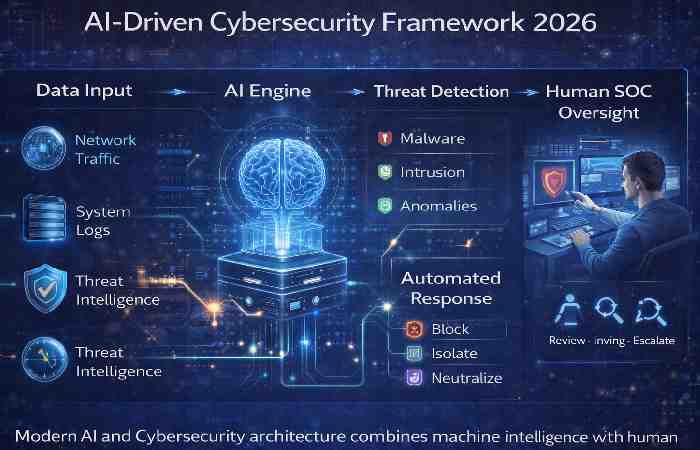
Visual Overview: AI and Cybersecurity Architecture in 2026
The Global Cyber Threat Landscape in 2026
Let’s be honest — cybercrime has become smarter.
In 2026, attacks are:
- Automated
- AI-generated
- Highly personalized
- Financially motivated
Hackers now use generative AI and cybersecurity weaknesses to create deepfake scams, automated phishing campaigns, and even AI-written malware.
According to reports from IBM and World Economic Forum, AI-enhanced cybercrime has significantly increased in sophistication compared to just a few years ago.
Core AI Technologies Used in Cybersecurity (2026)
| AI Technology | Purpose in Cybersecurity | Real-World Use Case |
|---|---|---|
| Machine Learning | Detects abnormal traffic patterns | Fraud detection in banking |
| Natural Language Processing | Identifies phishing & malicious emails | Email security systems |
| Behavioral AI | Monitors user activity deviations | Insider threat detection |
| Predictive Analytics | Forecasts future attack patterns | Threat intelligence platforms |
| Automated Response Systems | Isolates infected systems instantly | SOC automation |
This integration of AI and Cybersecurity reduces response time from hours to seconds.
Top 5 Countries Leading in AI and Cybersecurity (2026)
Global Cost & Platform Comparison Table
| Country | Avg Annual AI Cybersecurity Cost (Enterprise) | Popular Platforms/Apps | Online Availability |
|---|---|---|---|
| United States | $25,000 – $120,000 | CrowdStrike, Palo Alto Networks | Widely Available |
| United Kingdom | £18,000 – £90,000 | Darktrace, Sophos | High |
| India | ₹8,00,000 – ₹35,00,000 | Quick Heal, Tata Consultancy Services | Growing Rapidly |
| Germany | €20,000 – €100,000 | SAP Security, Secunet | High |
| Australia | AUD 30,000 – 110,000 | CyberCX, Fortinet | Medium–High |
Government-backed initiatives in these nations continue expanding AI and Cybersecurity solutions across critical infrastructure sectors.
Resource: https://www.ibm.com/reports/data-breach
The reality? AI and Cybersecurity are no longer optional upgrades — they are survival tools.
How AI and Cybersecurity Actually Work Together
You might wonder — what does AI really do in cybersecurity?
Here’s the simple version:
- AI watches everything.
It learns patterns.
It notices when something feels “off.”
Then it reacts instantly.
Modern AI and Cybersecurity systems use:
- Real-time anomaly detection
- Behavioral analytics
- Automated incident response
- Threat prediction models
- NLP-based phishing detection
Now, we’re even seeing the rise of agentic — where AI systems don’t just detect threats but independently investigate and contain them.
It’s like having a 24/7 digital security team that never sleeps.
AI and Cybersecurity Tools Comparison (2026)
| Tool Type | AI Capability | Best For | Cost Range (Global Avg) |
|---|---|---|---|
| AI SIEM Systems | Real-time log analysis | Large enterprises | $10k–$100k |
| AI Endpoint Detection | Malware prevention | SMEs & Enterprises | $5k–$50k |
| AI Cloud Security | Cloud misconfiguration detection | SaaS Companies | $8k–$60k |
| AI Fraud Detection | Financial anomaly detection | Banks & Fintech | Custom pricing |
| AI Identity Protection | Behavioral biometrics | Remote teams | $3k–$30k |
Organizations implementing AI and Cybersecurity solutions report up to 60% faster threat containment.
For organizations using behavioral biometrics as part of identity protection, understanding the future of biometrics can provide additional context on how identity security is evolving.
AI and Cybersecurity Adoption by Industry (Global Data 2026)
| Industry | Adoption Rate | Key Use Case |
|---|---|---|
| Banking & Finance | 82% | Fraud monitoring |
| Healthcare | 67% | Patient data protection |
| Government | 74% | National security |
| Retail & E-commerce | 63% | Payment fraud detection |
| Technology Sector | 89% | Cloud security automation |
The finance and technology sectors lead global AI and Cybersecurity transformation.
Generative AI and Cybersecurity: A Double-Edged Sword
Generative AI is powerful — and that’s both exciting and risky.
On the good side:
- It helps simulate attacks for testing
- It improves threat detection models
- It automates SOC reporting
On the dangerous side:
- Hackers use it to craft realistic phishing emails
- It can generate malicious code faster
- It powers deepfake scams
That’s why AI and Cybersecurity strategies must evolve just as fast as generative AI tools do.
Real Benefits of AI and Cybersecurity in 2026
Let’s break it down in human terms.
Faster Response
- AI reacts in seconds — humans take minutes or hours. In cyberattacks, seconds matter.
Smarter Filtering
- Security teams used to drown in alerts. Now AI filters noise and highlights real risks.
Grows With Your Business
- Whether you’re a startup or a multinational enterprise, AI scales automatically.
Learns Over Time
- Every attempted attack makes the system stronger.
- Simply put, it help teams move from panic mode to prevention mode.
But Technology Alone Isn’t Enough
Even the best AI and Cybersecurity solutions need smart humans behind them.
Here’s what still matters in 2026:
Continuous Learning
- Cybersecurity isn’t static. New threats appear daily.
- Professionals are enrolling in:
- Course programs
- Course free certifications
- Masters in AI and Cybersecurity degrees
- Advanced AI security bootcamps
- Education is becoming just as important as technology.
Hands-On AI and Cybersecurity Projects
Learning theory is good — building real systems is better.
Popular AI and Cybersecurity projects include:
- AI-powered phishing detection tools
- Malware classification models
- Behavioral anomaly detection systems
- Automated incident response dashboards
- These projects help professionals prepare for real-world threats.
AI and Cybersecurity Jobs: A Growing Career Field
If you’re wondering about career potential — it’s booming.
It jobs are among the fastest-growing tech roles globally.
In-demand positions include:
- AI Security Engineer
- Cyber Threat Analyst
- Machine Learning Security Specialist
- AI SOC Automation Engineer
- Cybersecurity Data Scientist
Companies are actively hiring professionals trained in generative AI and cybersecurity defense strategies.
The demand for experts with a masters in it is especially rising across the U.S., UK, India, Germany, and Australia.
Future of AI and Cybersecurity
The future of AI in cybersecurity is expected to focus on automation, intelligent threat detection, and advanced protection systems. Leading organizations like Cisco, Palo Alto Networks, and CrowdStrike are already investing heavily in AI-based security solutions.
| Future Trend | Description | Impact on Cybersecurity |
|---|---|---|
| Autonomous Security Systems | AI will automatically detect and respond to cyber threats without human intervention. | Faster response and reduced damage from attacks. |
| Predictive Threat Intelligence | AI will analyze past data to predict future cyberattacks. | Helps organizations prevent attacks before they occur. |
| Zero Trust Security | AI will continuously verify users and devices instead of trusting them by default. | Stronger protection against insider and external threats. |
| AI-Driven Cloud Security | Advanced AI tools will protect cloud platforms and sensitive data. | Increased security for remote work and digital transformation. |
| Behavioral Analytics | AI will monitor user behavior to detect unusual activities. | Early detection of insider threats and fraud. |
| AI in IoT Security | AI will secure connected devices and smart systems. | Protects smart homes, healthcare, and industrial networks. |
| Automated Vulnerability Management | AI will scan systems and fix weaknesses automatically. | Reduces risks and improves system safety. |
| Advanced Malware Detection | AI will identify new and unknown malware using machine learning. | Improves protection against evolving cyber threats. |
| Integration with Blockchain | AI and blockchain together will create secure digital transactions. | Enhances data integrity and security. |
| AI Against Ransomware | AI will detect and stop ransomware attacks in real time. | Protects businesses from financial losses |
As organizations prepare for these developments, the rise of quantum computing and its impact on cybersecurity is another important consideration for the future of digital security.
AI and Cybersecurity in Financial Systems
Banks and fintech companies were among the first to adopt AI-driven security.
Why? Because money attracts attackers.
AI now helps with:
- Fraud detection
- Transaction risk scoring
- Identity theft prevention
- Regulatory compliance automation
Financial institutions rely heavily solutions to reduce losses and maintain customer trust.
The Human + AI Hybrid Model
The strongest defense in 2026 isn’t AI alone.
- It’s AI + humans.
- Smart organizations combine:
- Automated detection
- Human decision-making
- Regular patching
- Multi-Factor Authentication
- Security awareness training
- Threat intelligence sharing
AI handles the speed.
Humans handle strategy.
Together, they create a resilient system.
Final Thoughts: Why This Matters More Than Ever
In today’s world, every organization is a tech organization.
Whether you’re running an e-commerce store, a hospital, a bank, or a government agency — your data is valuable.
- They are no longer just technical upgrades.
- They are business strategies.
- They are risk management tools.
- They are trust builders.
Organizations looking to strengthen these areas can also explore data protection and data security as an essential part of a broader cybersecurity strategy.
And as generative AI, automation, and digital transformation accelerate, organizations that invest in strong solutions will lead — while others struggle to keep up.
The message for 2026 is simple:
- Stay educated.
- Stay adaptive.
- Use AI wisely.
- And never stop evolving.